
1. Coyotes put out fires.
Whether this is true or myth, there’s a fascinating story from Hope Ryden’s book God’s Dog. She witnessed a coyote actually putting out a small fire. A man lit an envelope on fire and tossed it near a coyote. The coyote jumped on it, stamping out the flames with her feet, then pushed the smoldering paper against the ground until the fire was completely out. Apparently, coyotes have a knack for putting out small fires. That’s pretty incredible!
2. Both male and female coyotes have strong parental instincts.
Coyotes are a team when it comes to raising their pups. Both mom and dad work together to protect and care for their young. The male brings food, sometimes even regurgitating it for the pups, and helps teach them how to hunt. Coyotes have also been known to adopt orphaned pups, showing how deeply they value family.
3. Coyotes mate for life.
Coyotes form strong lifelong bonds with their mates. They are known to be highly monogamous, staying with the same partner “till death do us part.” Only when a mate dies do they find a new partner. This loyalty is seen especially in urban coyote populations and is truly a beautiful natural bond.
4. Coyotes are endemic to North America.
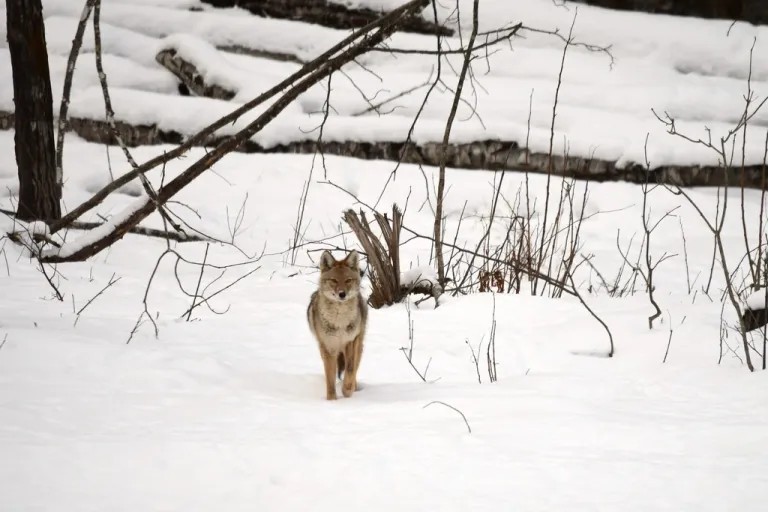
Coyotes are native to and found only in North America. They’re one of seven canid species in Canada and have adapted remarkably well across the continent’s many habitats.
5. Coyotes only breed once a year.
Their breeding season happens between January and March, and pups are usually born in April or May. Like many other canids, coyotes have just one breeding cycle per year.
6. There are melanistic (black) coyotes.
Melanistic coyotes, or black coyotes, are real! They aren’t a separate species, just a color variation caused by a genetic mutation that increases dark pigment in their fur. This mutation isn’t unique to coyotes—it also shows up in domestic dogs and wolves.
7. Coyotes are closely related to wolves and domestic dogs.
Coyotes, wolves, and dogs all belong to the same family, Canidae, and share the genus Canis. Despite this close relationship, coyotes are their own distinct species.
8. Coyotes have expanded their territories dramatically.
Over the last few decades, coyotes have spread across North America faster than any other carnivore, moving into new areas and adapting to a wide variety of environments.
9. Coyotes have been on Earth way longer than humans.
Fossil records show coyotes have been around for approximately 740,000 to 850,000 years. In comparison, modern humans have only existed for about 300,000 years.
10. Coyotes are sacred beings in Diné (Navajo) culture.
In Navajo stories, Mąʼii (Coyote) is one of the first sacred animals. Alongside Áłtsé Hastiin (First Man) and Áłtsé Asdzą́ą́ (First Woman), Mąʼii played a major role in creating and ordering the world. Coyotes are seen as teachers and creators, representing the balance between chaos and harmony.




 coyotepretty.ca