@projectcoyoteorg đ« Myth: âCoyotes lure dogs back to their pack!â â Fact: Coyotes are intelligent animals, but they don’t engage in premeditated luring. The belief that they intentionally lure dogs back to their packs is based on anecdotes rather than scientific evidence. #Mythbusting Coyotes are primarily opportunistic hunters and generally target smaller prey such as rodents and rabbits. They do not view dogs as potential prey unless the dog is significantly smaller or habituation by people has occurred. Coyotes generally avoid confrontation with humans and dogs, preferring to keep their distance. When encountering a dog, a coyote might yip or bark, which serves as communication or boundary-establishing behaviors. Luring a dog has the potential to put them and their family members (pack) at risk, which is not in the coyoteâs best interest. In many reported cases of dogs being âluredâ by coyotes, it is often a result of the dog’s own curiosity. Off-leash dogs may follow or investigate the coyote out of their own volition, which may cause the coyote to retreat closer to other family members for safety. If threatened, coyotes will defend their lives and their family, just like many other species. To coexist with coyotes, we must practice responsible pet care. Always supervise your pets, use a leash during walks, store attractants such as pet food or trash, and secure your yard. Avoid walking your dogs in areas with known coyote activity, especially during breeding and denning season. Share this with your family and neighbors to promote compassionate coexistence. #Myth #Coexistence #Pets #Coyote #Dogs #Wildlife #PetCare #animalsoftiktok #fyp đ· Sheryl Hester
⏠original sound – Project Coyote
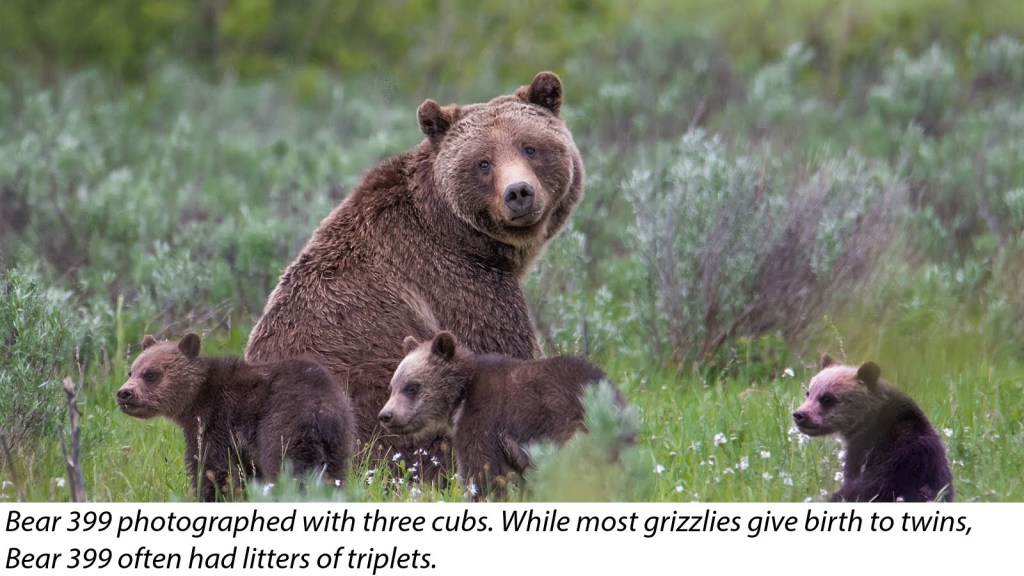
“Queen of the Tetons:” Remembering Bear 399
Life as a grizzly bear in the Lower 48 isn’t easy, but for 28 years, Bear 399 rose to the challenge.
Dubbed “Queen of the Tetons,” this charismatic mother gained fame successfully rearing cubs year after year.
In 2020 she became just the 14th grizzly ever known to give birth to quadruplets. In 2023, she became the oldest bear to give birth to a cub in the Greater Yellowstone Ecosystem.
But last October, Bear 399 gained a tragic title — she was the 51st grizzly struck and killed by a vehicle in the Greater Yellowstone area since 2009.
The life of 399 serves to illustrate both the achievements that have been made in grizzly bear rehabilitation in the Lower 48, and the long way we still have to go in learning how to coexist with these magnificent bears.

Not long ago, scientists feared the grizzly was doomed to extinction in the Lower 48. With as few as 300 left, grizzlies were granted protection under the Endangered Species Act in 1975. But by the mid-90s when Bear 399 was born, they were still struggling, with estimates placing the population around 400.
Over the course of Bear 399’s life, the population has expanded to an estimated 2,000 bears. Though still a far cry from the 50,000 bears that once traversed the western U.S. in the early 1800s, this remains an incredible achievement in species recovery, one that Bear 399 played a critical role in.
Bear 399 also served as an ambassador, revealing a softer side to a species written off by many as blood-thirsty brutes. In her leisurely strolls along roadways crowded with spectators, she demonstrated a lesser-known reality: like most wild animals, if given space and left alone, bears pose little threat to humans.
Of course, as humans continue to expand and move into grizzly habitat, space can become an issue. And more often than not, it’s the grizzlies who pay the price.
By one estimate, a heartbreaking 85% of all grizzly bears in the Lower 48 are killed because of humans before reaching old age.
Some bears are killed after hunting livestock, not understanding the differences between cows and wild elk. Some are poached illegally. Some bears are tempted by easy access to poorly-protected human food, and are euthanized in the interest of avoiding human-bear conflict down the road. Many are hit by cars.
Some of Bear 399’s cubs have suffered these fates.7 And in the end, Bear 399, too was killed by a human.
For too long, we have pitted bears against humans, either vying for the grizzly’s complete eradication, or allowing them to rebound while failing to address our own encroachment into their habitat.
It is time to forge an alternative path, one that gives bears the space to be bears, while also providing humans opportunities to appreciate these spectacular animals.
At Environmental Action, we’re advocating for the continued protection of grizzlies under the Endangered Species Act, working to increase wildlife crossings to limit animal collisions and supporting the preservation of wild areas where grizzlies can roam free.
So can humans and grizzlies coexist peacefully? If Bear 399’s life tells us anything, it’s that we can, but only so long as we’re willing to put in the work.
Thank you,
The Environmental Action team
â———————-â–â——–
To learn more about the Environmental Action team and what they do. Go to https://environmental-action.org/
Miss Sunshine
Totem # 5
Eastern Coyote, Canis Latrans

When a plant or animal can easily manage to survive and share the ever-changing world around humans, we frequently assign it one of two titles. âInvasiveâ (see above), or âPestâ. But what other words should we consider? âSuccessfulâ? âThrivingâ, now thatâs a word that doesnât apply to many species worldwide in this time of mass extinction. Maybe âAdaptableâ or âResilientâ, just as many of us have learned to be over the past few years.
The eastern coyote has been called all of these things. While they are indigenous to North America, their ancestors only moved into the northeast when colonists eradicated their biggest competition, wolves. With miles of forests, fields, and farmlands freshly available with no bigger predators to push them out, coyotes became very successful in the northeast. The subspecies that lives around us has genes from wolves and dogs too, but now for the most part they stick to groups of their own species. When big families get together they can get chatty (like a lot of human family gatherings, Iâd say), and their yelping and howling can make an evening feel like it has just a bit more wildness than before.
The eastern coyote is one of those animals that everyone is certain to be an expert in, even if maybe their facts are a bit exaggerated. That doesnât mean there arenât neat things to learn about this relatively common species!
Did you know that in addition to eating meat, coyotes spend their summers munching on insects, plants, and berries?
Did you know that the eastern coyote, while larger than the western subspecies, are still typically only 20 to 45 pounds? Thatâs about the size of a border collie or a cattle dog!
Did you know that in addition to farms and fields, coyotes have been known to live in the Bronx and Queens?
Did you know that coyotes help keep the ecosystem tidy and free of disease by eating roadkill and other carcasses?
Did you know that coyotes are monogamous and mate for life?
While they get blamed for all sorts of scary phenomenon and many people are nervous of all of our local predators, itâs important to remember that they are just doing what works well for them to survive. After all, we moved (and continue to move) into their spaces. But, coexisting with coyotes is possible!
https://wallkillvalleylt.org/2022/01/species-spotlight-coyote-and-mugwort/
VOLE FIGHTS BACK
Voles are a favorite food of coyotes. Not when they fight back đ€
A king among coyotes//
Farewell, old friend: An obituary for Kip the Coyote

Kip the Coyote wasnât just another furry friend on UBC campus â from sunbathing on the lawns of Place Vanier to chasing squirrels down Main Mall, Kip has touched the hearts of UBC students for years.
It is with a heavy heart that we report Kip passed away sometime during the first weekend of October.
Although the passing of this beloved UBC critter has left students heartbroken, Kipâs death has helped us gain a better understanding of other wild creatures in urban spaces, including those living at UBC.
Not only was Kip a campus icon, he was also a perfect representation of how animals and humans interact, especially in a heavily populated area such as Point Grey. His life will hopefully lead to further insight on how we can encourage wildlife protection and conservation.
âKip will now help us learn more about how urban coyotes survive and thrive in these harsh environments,” wrote UBCâs Animal Behavior and Cognition (ABC) Lab in an Instagram post. “His previous injury, likely from a vehicle strike, and ability to heal and survive, tells the story of how urban wildlife face both hindrance and help from life in cities.”
âHis memory will live on as we use what we learn from him to better understand urban wildlife and the challenges they face.â
Letter: Maine should stop coyote killing contests

A coyote makes its way through the snow in northern Maine. (Courtesy of Keith Dirago | Mainely Wildlife Photography)
I cannot even begin to comprehend how there are individuals in this state who take part in coyote killing contests, and that these barbaric events are allowed by the Maine Department of Inland Fishies and Game. I believe these contests are inhumane and serve absolutely no purpose other than to torture animals.
All creatures were put on this earth for a reason, and each species plays an important role in keeping the ecosystem balanced. Coyotes play an extremely important role in keeping rodent and small mammal populations in check. They eat the wildlife that harbor ticks, such as the white footed mouse, which is the principal natural reservoir for Lyme disease bacteria. Eastern chipmunks and shrews are also moderately competent reservoirs for the Lyme disease bacteria.
Lyme disease is a serious problem impacting a significant number of Maine residents. If we want to decrease the number of cases of Lyme disease in Maine, our lawmakers need to look at the big picture and truly understand how we can solve this. Killing the main predator of the white footed mouse and other small mammals, certainly is only going to exacerbate the spread of Lyme.
I encourage everyone who cares about a healthy ecosystem, working towards eradicating Lyme disease and for the ethical treatment of all animals, to please contact your state representative and senator and let them know your thoughts on this matter.
Janie WhitneyBar Harbor
Letter: Maine should stop coyote killing contests
Stop Congress’s Attack on Wolves and the Endangered Species Act!

Urge your Representative to Oppose H.R. 845!
The war on wolves is escalating in Congress, and they urgently need your voice!
U.S. House Representatives Lauren Boebert (R-CO) and Tom Tiffany (R-WI) have introduced a bill H.R. 845, that would strip wolves of their vital federal protections under the Endangered Species Act (ESA). Even worse, the bill would block judicial review, preventing any legal challenges to this harmful and destructive legislation. Tell your Representatives to vote NO on H.R. 845!
The intent is clear: weaken federal oversight so more wolves can be killed. The last time wolves lost ESA protections, Wisconsin hunters slaughtered nearly 220 wolves in less than three daysâalmost twice the state’s limit. A judge later restored protections for most wolves in the U.S. (except in the Northern Rockies), recognizing the chaos that followed delisting.
With the deceitful name âPet and Livestock Protection Act,â H.R. 845 perpetuates the myth that wolves are a major cause of farm animal deaths. In reality, years of state and federal data show that wolves are responsible for less than 1% of farmed animal deathsâfar behind disease, weather, and natural causes
As history has shown, taking wolves off the ESA list guarantees their rampant killing and persecution. Please join us in advocating for proper protection for wolvesâone of the nation’s most ecologically critical and iconic species.
Join us in urging Congress to vote NO on H.R. 845!
Stop Brian Nesvik from leading the U.S. Fish and Wildlife Service!
President Trump has nominated Brian Nesvik to head the U.S. Fish and Wildlife Serviceâa disastrous choice for wildlife. Nesvik has a long history of undermining the Endangered Species Act, prioritizing development over conservation, and failing to hold wildlife abusers accountable.
His leadership would put wolves, sage-grouse, and other imperiled species at even greater risk. We need a Fish and Wildlife Service Director who will protect wildlife and their habitat, not hand it all over to extractive industries.
Contact your elected officials today and urge them to oppose Nesvikâs nomination!
Your senators are CC’ed on the email message and will receive it with your representative.
https://action.wildearthguardians.org/page/79523/action/1?ea.url.id=3337343&forwarded=true