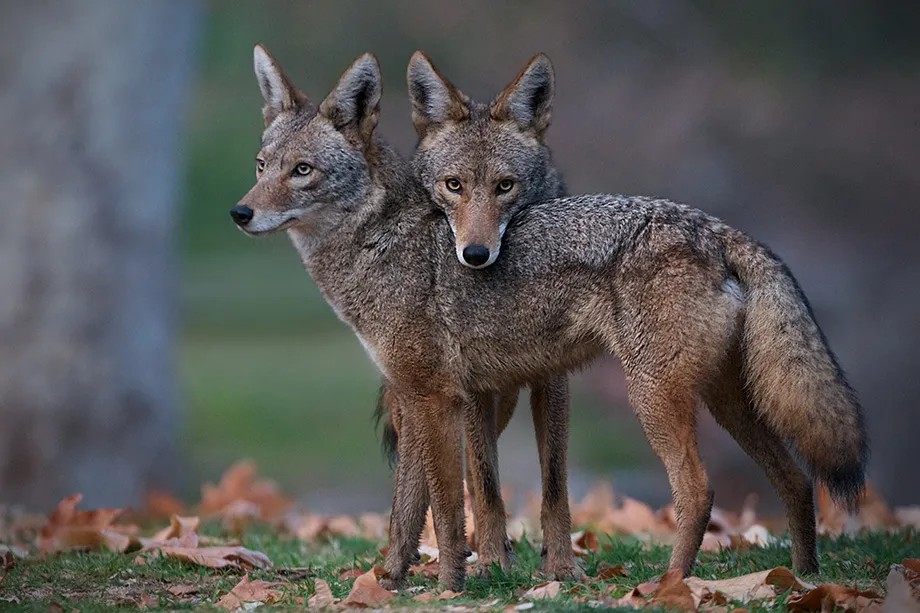
Pair of coyotes, photograph by Sean Crane
Coyotes (canis latrans) and golden jackals (canis aureus) share several intriguing similarities, especially in terms of their adaptability and ability to expand their territories in response to environmental changes.
Both species have demonstrated impressive resilience and resourcefulness, allowing them to thrive in a variety of habitats.
Some similarities between coyotes and golden jackals that might explain their territorial expansion.
Adaptability to Changing Environments
Both coyotes and golden jackals are incredibly adaptable animals. They have learned to live in a variety of environments, from rural areas and agricultural lands to urban spaces.
This ability to adjust to different landscapes, food sources, and climate conditions is one of the main reasons they’ve been able to expand their territories.
Coyotes have been able to adapt to urbanization in North America, living in cities and suburbs, where they find ample food sources such as rodents and garbage. This flexibility has allowed them to push further into areas previously dominated by humans.
Golden jackals have also shown remarkable adaptability. They’ve expanded their range from their native regions in Asia, the Middle East, and parts of Africa, moving into Southeastern Europe, and now even Central Europe, likely due to the availability of food and less competition from larger predators.
Opportunistic Diet
Both species are opportunistic omnivores, meaning they can survive on a wide variety of food. This flexibility in diet enables them to thrive in changing environments, particularly where other animals may struggle.
Coyotes will eat small mammals, fruits, birds, insects, and even plants, making them highly adaptable to different environments. Their ability to scavenge human food also helps them survive in urban settings.
Golden jackals also have a varied diet, feeding on everything from small mammals and birds to fruit and even carrion. In fact, like coyotes, they are known to scavenge from human settlements when necessary.
Expansion into New Territories
Both species have been able to expand their ranges due to human-induced changes in the environment. As human development spreads, they move into new areas where resources are available, often without much competition from larger predators.
Coyotes expanded their range significantly in the 20th century, moving from the western United States to all parts of North America, even as far as Central America. Their ability to avoid conflict with other predators like wolves and their skill in adjusting to urban environments contributed to this expansion.
Golden jackals, once confined to parts of Asia and Africa, have expanded into new regions in Europe and are now found in places like Greece, Croatia, and even the Balkans.
Some researchers believe their range expansion has been driven by factors such as climate change, loss of natural predators, and the availability of food from human settlements.
Social Structure and Behavior
Both coyotes and golden jackals are known for their social structures. They live in small family units or packs, which helps them effectively hunt and defend territory.
Coyotes are often seen alone or in small family groups. They are highly social within their packs and have complex communication systems to hunt together and protect territory.
Golden jackals also live in family units and are highly social animals. They are known for hunting in pairs or small groups, and their ability to cooperate in groups helps them exploit food sources in both rural and urban areas.
Ability to Coexist with Humans
Both species have developed an unusual ability to coexist with humans, at least to a degree. While some conflict may occur, especially in rural or agricultural areas, both species have shown that they can adapt to human presence and even benefit from human waste or food.
Coyotes have found ways to live in urban areas, where they may roam through parks, neighborhoods, and even city streets. Their ability to adapt to human spaces has allowed them to thrive despite their growing population.
Golden jackals are less commonly found in urban spaces compared to coyotes, but their range expansion into human-dominated landscapes, including agricultural regions, shows they are similarly able to adjust to human environments.
Resourceful and Resilient
Both coyotes and golden jackals are incredibly resilient species. They are survivors, able to deal with challenges such as predators, environmental changes, and food scarcity.
Coyotes have dealt with the eradication efforts made against them in the past and are now one of the most widespread carnivores in North America.
Golden jackals have successfully expanded their range despite the challenges of living alongside human populations, showing their resilience in the face of threats such as habitat loss and competition with larger carnivores.
Challenges of Expanding Territories
While both species are incredibly resourceful and adaptable, their expansion into new territories isn’t always without conflict.
Coyotes often encounter competition with larger predators like wolves or mountain lions, which can limit their ability to expand into certain regions.
Golden jackals face competition from wolves in Europe, which can restrict their movements in some areas, but they are still thriving in places where wolves are less common.
The similarities between coyotes and golden jackals highlight their incredible adaptability, resourcefulness, and ability to thrive in changing environments. Their ability to expand their territories despite human development and increased competition shows how these species are able to adjust to new challenges and continue to flourish.
Their success in new environments could also be seen as a testament to their resilience and intelligence, which enables them to carve out niches in landscapes where other animals may struggle.
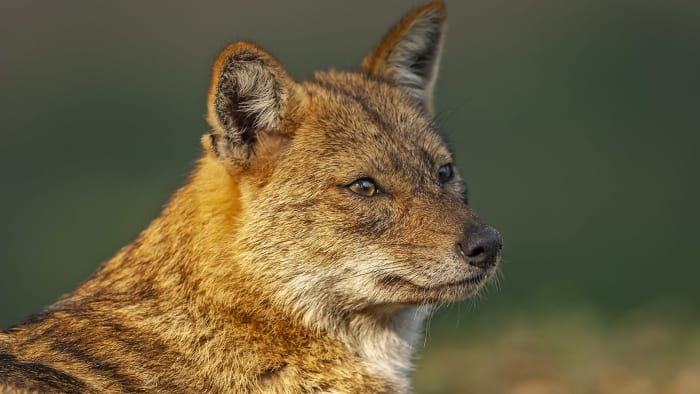
A golden jackal

 coyotepretty.ca